
Understanding Cardiomyopathy and Genetic Testing
Cardiomyopathy is a serious heart problem and one of the main causes of heart failure and sudden heart-related death. Many people don’t know that up to half of all cases are genetic—meaning the condition can be passed down through families and affect several generations.
Genetic testing can help find out what caused your cardiomyopathy, guide your doctor in choosing the right treatment, and give your family important information that could even save lives.
Doctors and medical experts recommend by current medical guidelines:
Genetic testing for people with non-ischemic cardiomyopathy
➤ where it can help find the cause or guide treatment.
Genetic testing for close family members
➤ if a genetic cause is found, to help find the condition early and reduce the risk of serious problems.
Even with these recommendations, studies show that fewer than 2% of people with cardiomyopathy have had genetic testing—leaving many families without the answers they need.
To help close this gap, the Genetic Cardiomyopathy Awareness Consortium is helping connect patients with several genetic testing companies that offer testing to cardiomyopathy patients and their family members. See below for testing options.
What About Family Members?
Adult First-Degree relatives where a family member has tested positive for genetic cardiomyopathy —- close relatives, especially parents, siblings, and children, may also carry the same variant and should be tested.
Why Is Testing and Re-Testing Important?
Click the videos below to learn why testing and retesting is important, and understanding genetics and your test results.
How Genetic Testing Can Improve Your Care
When to Get Genetically Retested
Understanding Genetic Test Results
Testing Options
Below are several testing options where you may order genetic testing or a family member may order genetic testing once a relative with cardiomyopathy has completed initial testing and has a positive test result.
Note: If you have already been tested for cardiomyopathy, you must be retested by one of these providers below to qualify for free family testing.
Testing option where a Patient and Family Members can order the test themselves.
Click on logo to order a test.

Formerly Everygene
Free to patient
Free to family members
Available in the US only
Testing options where a physician or genetic counselor must order the test:
Click on logo to order a test.

Patient Insurance accepted, $0-100 average out of pocket cost
Family members free w/in 90 days of patient ordering test
Available in the US and Canada only
Formerly Everygene
Free to patient
Free to family members
Available in the US only

Patient Insurance accepted; financial aid if qualify; Unlock program which includes sponsored, no cost testing for under insured or no insurance.
Family members free within 150 days of patient ordering test
Available in the US and international
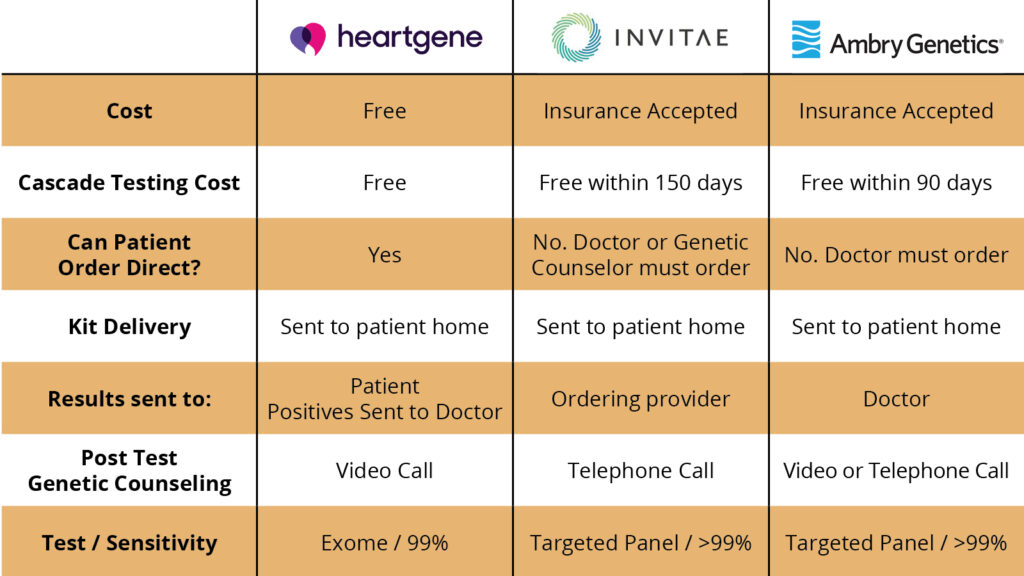
Testing Options Summary Chart
See the Complete Testing Comparison Chart to learn more about the details around Ambry, Everygene and the Invitae tests.
REFERENCES
Polovina, M., Tschöpe, C., Rosano, G., Metra, M., Crea, F., Mullens, W., Bauersachs, J., Sliwa, K., de Boer, R. A., Farmakis, D., Thum, T., Corrado, D., Bayes-Genis, A., Bozkurt, B., Filippatos, G., Keren, A., Skouri, H., Moura, B., Volterrani, M., Abdelhamid, M., … Seferović, P. M. (2023). Incidence, risk assessment and prevention of sudden cardiac death in cardiomyopathies. European Journal of Heart Failure, 25(12), 2144–2163. https://doi.org/10.1002/ejhf.3076
Bozkurt, B., Colvin, M., Cook, J., Cooper, L. T., Deswal, A., Fonarow, G. C., Francis, G. S., Lenihan, D., Lewis, E. F., McNamara, D. M., Pahl, E., Vasan, R. S., Ramasubbu, K., Rasmusson, K., Towbin, J. A., & Yancy, C. (2016). Current diagnostic and treatment strategies for specific dilated cardiomyopathies: A scientific statement from the American Heart Association. Circulation, 134(23), e579–e646. https://doi.org/10.1161/CIR.0000000000000455
Ahmad, F., McNally, E. M., Ackerman, M. J., Baty, L. C., Day, S. M., Kullo, I. J., Madueme, P. C., Maron, M. S., Martinez, M. W., Salberg, L., Taylor, M. R., & Wilcox, J. E. (2019). Establishment of specialized clinical cardiovascular genetics programs: Recognizing the need and meeting standards: A scientific statement from the American Heart Association. Circulation: Genomic and Precision Medicine, 12(6), e000054. https://doi.org/10.1161/HCG.0000000000000054
Hershberger, R. E., Givertz, M. M., Ho, C. Y., Judge, D. P., Kantor, P. F., McBride, K. L., Morales, A., Taylor, M. R. G., Vatta, M., & Ware, S. M. (2018). Genetic evaluation of cardiomyopathy: A Heart Failure Society of America practice guideline. Journal of Cardiac Failure, 24(5), 281–302. https://doi.org/10.1016/j.cardfail.2018.03.004
Heidenreich, P. A., Bozkurt, B., Aguilar, D., Allen, L. A., Byun, J. J., Colvin, M. M., Deswal, A., Drazner, M. H., Dunlay, S. M., Evers, L. R., Fang, J. C., Fedson, S. E., Fonarow, G. C., Hayek, S. S., Hernandez, A. F., Khazanie, P., Kittleson, M. M., Lee, C. S., Link, M. S., Milano, C. A., … Yancy, C. W. (2022). 2022 AHA/ACC/HFSA guideline for the management of heart failure: A report of the American College of Cardiology/American Heart Association Joint Committee on Clinical Practice Guidelines. Journal of the American College of Cardiology, 79(17), e263–e421. https://doi.org/10.1016/j.jacc.2021.12.012
Morales, A., Moretz, C., Ren, S., Smith, E., Callis, T. E., Hall, T., Hatchell, K. E., Nussbaum, R. L., Regalado, E., Rojahn, S., Vatta, M., Esplin, E. D., & Murillo, J. (2024). Real-world genetic testing utilization among patients with cardiomyopathy. Circulation: Genomic and Precision Medicine, 17(1), e004028. https://doi.org/10.1161/CIRCGEN.122.004028